
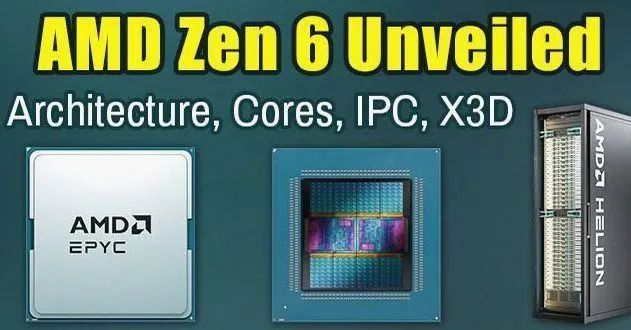
AMD has officially pulled back the curtain on its next generation of server power, unveiling the EPYC 9006 Venice and Verona processors. Driven by the brand new Zen 6 microarchitecture and built on TSMC’s cutting edge 2 nanometer process, these chips represent a seismic shift in computing density. While consumers will have to wait a bit longer for Ryzen desktop updates, the server market is getting an immediate boost via the SP7 package, which introduces significant leaps in both instructions per clock and overall core counts.
The technical heart of this update lies in a dual approach to chiplet design. For high performance tasks, AMD has expanded its standard compute dies to house 12 cores instead of eight, marking the first major capacity jump for these components in nearly a decade. However, the real star is the Zen 6c compact core. By refining these space saving cores, AMD can now cram a staggering 32 cores into a single compact die while doubling the available cache per core. This efficiency allows some top end configurations to reach an unbelievable total of 256 cores and 512 threads within a single socket.
Beyond raw core numbers, AMD is pushing the boundaries of data movement with several industry firsts. These processors introduce PCIe Gen 6 support and utilize JEDEC standard MRDIMMs across 16 memory channels to achieve massive bandwidth levels reaching 1.6 terabytes per second. According to company data, this architecture delivers roughly double the integer throughput of its predecessor and provides a substantial bump in AI workload efficiency, boasting up to a thirty one percent improvement in specific artificial intelligence tasks.
While these figures are currently focused on enterprise and cloud environments rather than gaming or home productivity, the implications for scale are enormous. Microsoft Azure has already begun previewing instances powered by Venice technology, signaling a rapid rollout across global data centers. As AMD continues to ship these platforms through 2027, the industry moves closer to a reality where half a thousand threads can operate from one piece of silicon, fundamentally changing how cloud infrastructure handles massive datasets.